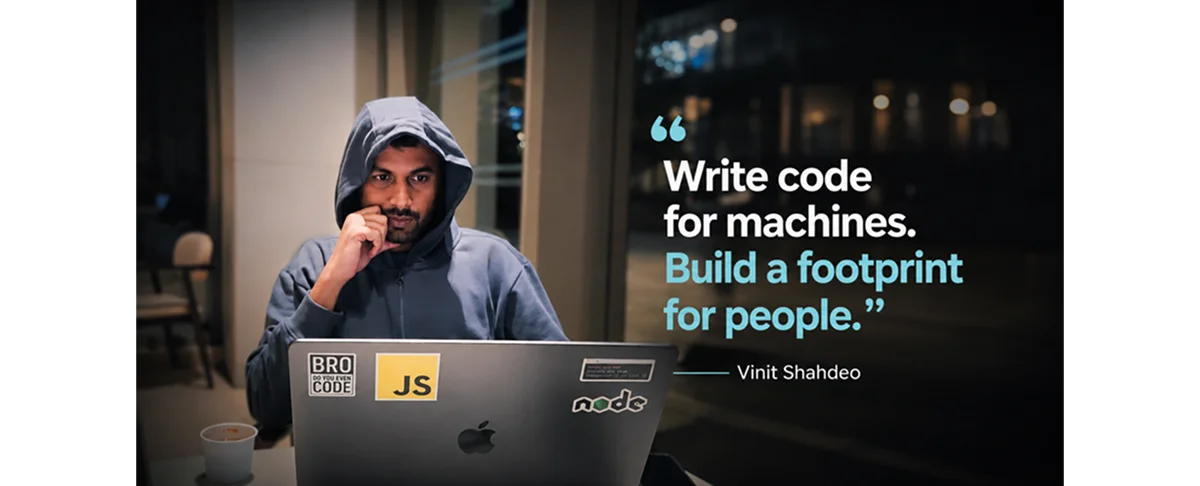
“Write Code for Machines. Build a Footprint for People,” Says Vinit Shahdeo
The GitHub Star’s first book, Digital Footprint for Software Engineers, argues that in an AI-shaped hiring market, a visible body of work now matters more than a polished resume. It’s available on Amazon.
“Write code for machines. Build a footprint for people.” That single line runs through Vinit Shahdeo’s first book, Digital Footprint for Software Engineers, and it sums up the case he is making to developers everywhere. The code you write is for computers. The record of that work is for the people who decide what happens to your career.
Shahdeo, a three-time GitHub Star and long-time open-source contributor from India, wrote the book around a problem he watched play out for years. Skilled engineers ship excellent work every day and stay invisible outside their own teams. Meanwhile, interviews, promotions, and recognition tend to reach the people who are easy to find. His claim is direct. That gap is rarely about ability. It’s about visibility, and visibility can be built on purpose.
The book is careful about what it means by “digital footprint”. It isn’t chasing followers or posting for an algorithm. It’s the sum of how your work shows up when someone goes looking: your GitHub history, the way you explain a hard problem in writing, a portfolio that shows what you actually built, the questions you answer in public. In plain terms, it’s whether a stranger can understand what you do and trust that you’re good at it, without ever meeting you.
The timing gives the argument extra weight. Hiring has moved online and gone async, and AI can now turn out a clean, keyword-perfect resume in minutes. When every application looks polished, the resume stops separating people. What still holds up is real work that lives in public and has built up over time, because that is the one thing that can’t be generated on demand. A footprint has a history. That history is what makes it credible.
True to Shahdeo’s style, the book avoids hype and reads like something an engineer would actually write. Rather than theory, it offers habits a developer can start this week: building a GitHub profile that signals ownership, writing about your work without performing, using platforms like LinkedIn and X with intent instead of burning out, and staying discoverable on Google while protecting your privacy. It’s written for engineers at every stage, from those trying to stand out early in their careers to senior developers whose impact never travels past their own organization.
Shahdeo is also honest about the pace. A real footprint isn’t built in a launch week. It comes one repository, one post, and one contribution at a time, and it pays off only for people who keep at it. Done that way, he argues, the results arrive on their own. People start knowing your name. Your work starts circulating without you pushing it. Trust builds before a conversation even begins.
Digital Footprint for Software Engineers, by Vinit Shahdeo, is now available on Amazon.
About Vinit Shahdeo
Vinit Shahdeo is a software engineer, three-time GitHub Star, and open-source contributor. He has built and scaled backend systems at startups and technology companies, mentored engineers through community and open-source programs, and writes regularly on backend engineering, distributed systems, and building a career in tech. Digital Footprint for Software Engineers is his first book.