From Babble to Narrative: How Visual Storytelling Shapes Early Communication
In the earliest years of life, long before report cards and classrooms, something quietly powerful is unfolding.
A toddler points at a bird and says, “ba.”
A parent smiles and replies, “Yes, bird!”
It seems like a small exchange. But in that moment, something much bigger is happening. A sound connects to an image. The image connects to meaning. Meaning connects to emotion.
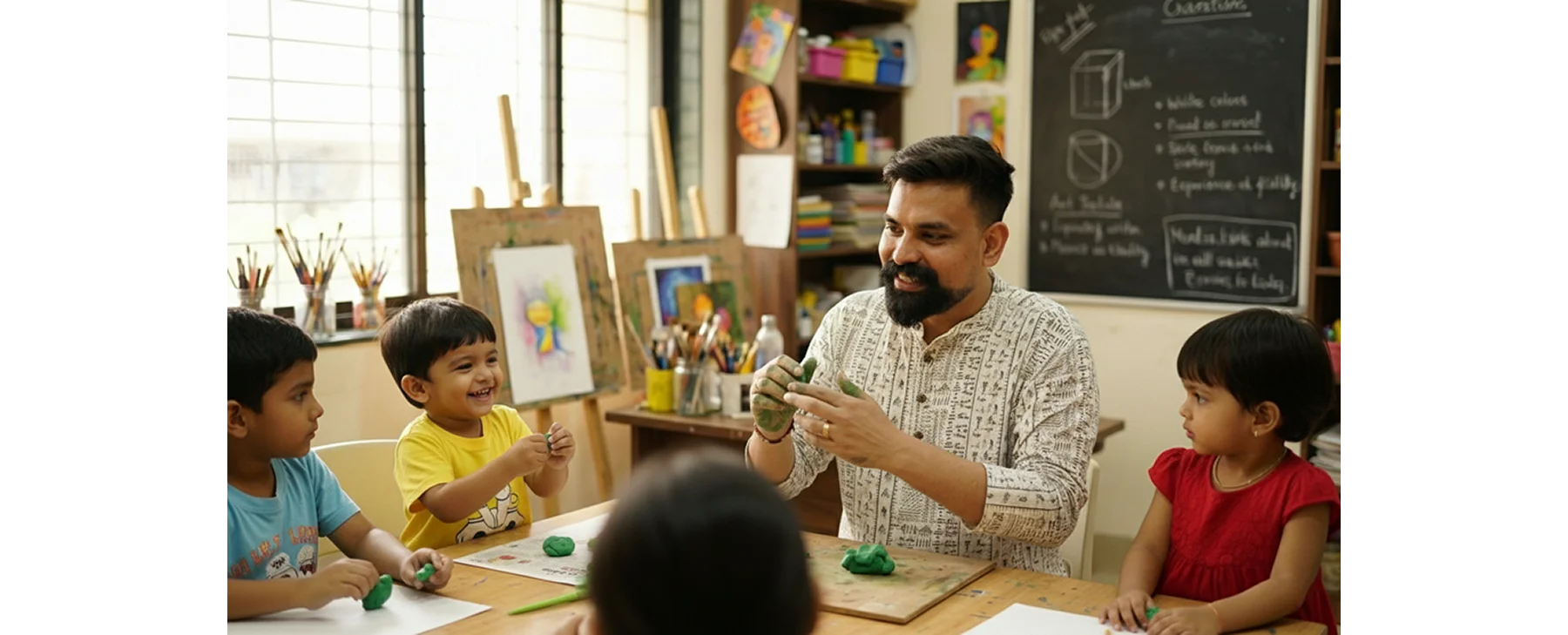
For Devesh Waghela — communication designer, design educator, and PhD researcher — these moments are not casual milestones. They are the beginning of human expression.
“Communication doesn’t begin with grammar,” Waghela says. “It begins with connection. And stories are often the first bridge.”
For him, storytelling and visual learning aren’t add-ons in early childhood. They are the foundation on which confidence, empathy, and clarity are built.
Beyond Just Naming Things
In many early learning spaces, communication is treated as repetition. Say the alphabet. Name the fruit. Repeat the rhyme.
Repetition has its place, Waghela agrees. But without context, it becomes mechanical.
“Children don’t just collect words,” he explains. “They search for meaning. And meaning lives inside stories.”
When a child hears a story, they aren’t sitting passively. They are imagining what happens next. They are reading facial expressions. They are connecting emotions to actions. They are building invisible frameworks inside their minds.
Research from the Center on the Developing Child shows that early language exposure actually shapes brain development. But Waghela believes the science only confirms what we already observe — children thrive when language feels alive.
“Storytelling turns vocabulary into experience,” he says. “And experience stays.”
Language Grows in Relationship
Psychologist Lev Vygotsky believed that language develops through social interaction. In simple terms: children learn to speak by being spoken with, not spoken at.
“When a toddler points at a picture and looks back at you for confirmation,” Waghela reflects, “that shared glance is language forming.”
Similarly, Jean Piaget described how children build understanding through active engagement. A puppet show. A picture book. A set of illustrated cards. These aren’t distractions — they are invitations.
“Storytelling is participatory,” Waghela says. “The child isn’t consuming content. They are helping create it.”
Why Visuals Make Such a Difference
Before children become fluent speakers, they are already fluent observers.
They read faces. They notice colours. They recognise patterns. They understand tone before they understand words.
This is why visual storytelling matters so deeply.
“A good image gives language a place to land,” Waghela explains. “It makes the abstract feel tangible.”
Studies supported by the American Academy of Pediatrics consistently show that shared reading — especially with picture-rich books — strengthens both expressive and receptive language.
Visual cues help children:
- Connect objects to sounds
- Understand sequences
- Identify emotions
- Develop imagination
“When image and story come together,” Waghela says, “learning feels natural. It doesn’t feel forced.”
Communication Is Emotional First
One of Waghela’s strongest beliefs is that communication isn’t just about speaking clearly. It’s about feeling understood.
“A child who can say ‘I am sad’ instead of simply crying has already taken a huge step,” he says.
Early childhood frameworks from UNICEF emphasise that emotional expression is directly linked to long-term social well-being.
Stories give children safe rehearsal spaces. Through characters, they explore fear, sharing, jealousy, joy. They learn words for feelings they don’t yet fully understand.
“When emotions appear in a story,” Waghela explains, “they become less overwhelming. They become discussable.”
And discussion builds confidence.
From Screens to Story Worlds
Waghela is careful to draw a line between visual learning and passive screen time.
“Visual learning is not about fast-moving graphics,” he says. “It’s about interaction.”
He encourages:
- Sitting together with a picture book
- Asking open-ended questions
- Using puppets for dialogue
- Letting children retell stories in their own way
- Drawing scenes from imagination
When children retell a story, something shifts.
“They stop being listeners,” he says. “They become narrators.”
And narration builds ownership.
Designing Spaces That Invite Expression
For Waghela, storytelling isn’t only about books. It’s about environment.
A classroom wall with illustrated story sequences.
A quiet corner filled with props and soft cushions.
A teacher who pauses and waits for a child to respond.
“Design isn’t decoration,” he says gently. “It shapes behaviour.”
An inviting storytelling space encourages collaboration. A well-placed visual prompt sparks conversation. Even voice modulation during narration can influence attention and rhythm.
“Children speak more in spaces that feel safe,” Waghela says. “Not in spaces that feel evaluative.”
The Long View
The World Health Organization recognises communication as a foundational life skill linked to academic success, emotional resilience, and social adaptability.
But Waghela frames it more personally.
“The way a child learns to tell a story at three,” he says, “influences how they present an idea at twenty-three.”
Early narrative experiences become internal dialogue. They shape confidence. They shape clarity.
Not Preparation — Formation
Too often, early childhood education is described as preparation for school.
Waghela disagrees.
“It’s not preparation,” he says. “It’s formation.”
When we read stories to toddlers. When we pause and listen to their half-formed sentences. When we respond to their pointing and babbling — we are not just teaching language.
We are shaping voice.
And perhaps in a world that grows louder and more complex each day, the most meaningful gift we can offer a child is simple:
The confidence to speak.
The freedom to imagine.
The ability to connect.
One story at a time.
References (APA 7th Edition)
American Academy of Pediatrics. (2014). Literacy promotion: An essential component of primary care pediatric practice. Pediatrics, 134(2), 404–409. https://doi.org/10.1542/peds.2014-1384
Center on the Developing Child at Harvard University. (n.d.). Brain architecture. Harvard University. https://developingchild.harvard.edu/science/key-concepts/brain-architecture/
Piaget, J. (1952). The origins of intelligence in children. International Universities Press.
UNICEF. (2017). Early childhood development. United Nations Children’s Fund. https://www.unicef.org/early-childhood-development
Vygotsky, L. S. (1978). Mind in society: The development of higher psychological processes. Harvard University Press.
World Health Organization. (1999). Partners in life skills education: Conclusions from a United Nations inter-agency meeting. World Health Organization. https://apps.who.int/iris/handle/10665/63552