Property Transfers Between Parents and Children: What Delhi Law Says
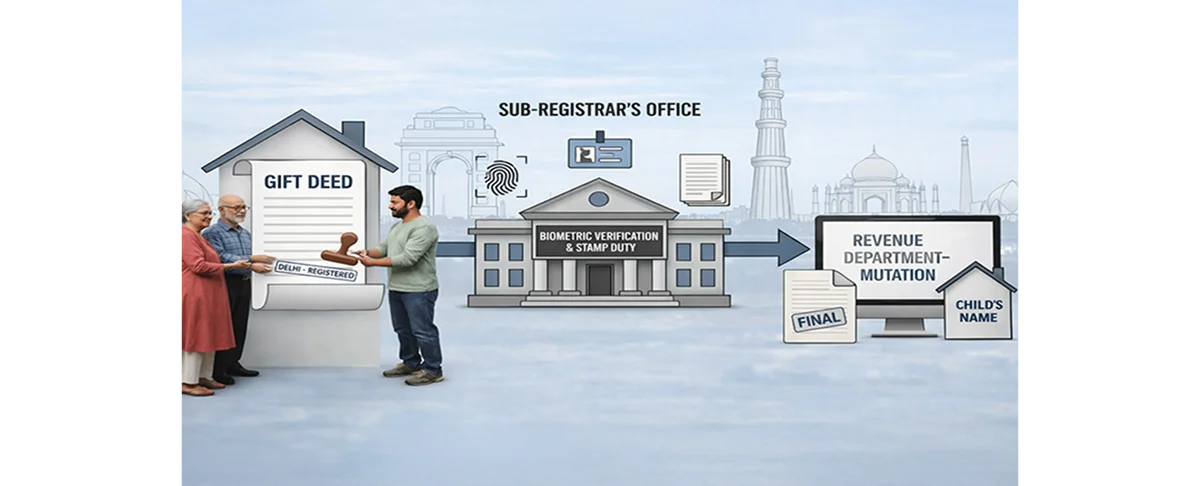
In Delhi, most parents who want to hand over property to their children during their lifetime do it through a gift deed. It’s a straightforward method recognized under Section 122 of the Transfer of Property Act, 1882, and it takes effect immediately once registered. Since the transfer involves no money, the law treats it as a voluntary act, and after registration under Section 17 of the Registration Act, 1908, the transfer becomes final. A gift deed can’t be changed later, which is why property advocates at AM legal advise families to prefer it over a will. It gives you clarity and an undisputed title in the present.
How Gift Deeds Work in Delhi
A gift, in law, is just the transfer of property without any payment involved. When parents gift a house or flat to their child, the deed simply states what the property is, the relationship, and that the transfer is voluntary. The parent signs as the donor, the child accepts it, and two witnesses attest the deed.
Once drafted, the deed must be taken to the Sub-Registrar’s Office (SRO) where the property is located. Registration isn’t optional. It’s what gives the deed its legal effect. Delhi’s SROs require biometric verification for both donor and donee, along with basic ID documents such as Aadhaar, PAN, passport, voter ID etc.
What the Registration Process Looks Like
Most families begin by preparing the deed on e-stamp paper after paying stamp duty through the DORIS portal or SHCIL. Along with the deed, the SRO will ask for the title papers, the encumbrance certificate, circle rate proof, Aadhaar and PAN, and a document showing the parent-child relationship.
At the time of registration, you pay a 1% registration fee on the property value, plus Rs 100 as pasting charges. The verification, biometrics and approval typically take a few days, and the certified registered copy is usually ready within 7–14 days.
Stamp Duty in Delhi (2025): What Parents Should Know
Delhi does not offer special concessions for gifting property to children, so the normal stamp duty applies. The calculation is based on the higher of circle rate or market value.
For male children, the stamp duty is 6%. For female children, it’s 4%. In certain cases where the property value exceeds Rs 25 lakhs, an additional 1% applies. Registration itself adds another 1% of the property value. The DORIS calculator is the simplest way to get an accurate figure before visiting the SRO.
The essential paperwork includes the gift deed, title documents, NOCs, ID proofs, two photos each, and the circle rate certificate. After registration, the next step is mutation with the revenue department so that government records reflect the child as the new owner. Property advocates in Delhi can help you update property tax and utility details in the child’s name.
Under Section 56(2)(x), a gift from a parent to a child isn’t taxed. After the transfer, the property’s value isn’t treated as income.
Benefits and a Few Things to Watch Out For
Gift deeds are often chosen for their clarity and simplicity. The transfer is immediate, children get secure ownership, and the chances of future dispute reduce sharply. For estate planning in joint families, this method avoids complications that can arise later with wills.
A few checks are important before gifting property. Ensure the title is clear, there are no encumbrances, and the value matches the circle rate to avoid any penalties.Property lawyers in Delhi can perform the due diligence so that the entire process is conducted with safety and certainty. After registration, a gift deed usually can’t be taken back, so both sides should be sure before signing.
If the property is ancestral and there are multiple heirs, a gift deed may not be the best pick.
Many families instead explore partition deeds to avoid challenges later. Clear drafting and proper due diligence do their bid in making transfers smooth and fully compliant.
A well-executed gift deed can be one of the clearest ways for parents in Delhi to transfer property to their children during their lifetime. Property advocates at AM Legal handle valuation, title checks, and registration properly, so that the process is not only smooth but also offers long-term legal certainty. It removes ambiguity about ownership, prevents future disagreements, and keeps family arrangements transparent.
For many families, this clarity matters as much as the transfer itself. A diligently drafted deed ascertains that the child receives undisputed ownership from the get go, without waiting for probate or dealing with competing claims later. And because the law treats registered gift deeds as final, it gives both sides confidence that the arrangement will hold. AM Legal can professionally guide you to prepare a solid gift deed. A gift deed remains one of the most dependable tools for safeguarding family property and passing it on exactly as intended.